Now & Zen, Inc - 800-779-6383
Zen Alarm Clock Digital Zen Alarm Clock Zen Timepiece Zen Doorbell Tibetan Phone Bell & Timer Integral Consciousness

Secure Site

Now & Zen Blog

Archive for the 'Zen Timers' Category

Zen Timers are useful to begin and end meetings or meals

Thursday, June 30th, 2011
Tea House Meditation

Tea House Meditation

In addition to personal and contemplative uses, the Zen Timers can also be used as a progressively persistent, yet gentle way to bring people together for meetings or sessions, and to disperse them when their meeting time is over.

Having a timer set to signal the end of a meeting can be very useful, especially in intense situations where it is socially difficult to play the role of “meeting police” by cutting people off at the allotted end time.  Yet the buzzing of an ordinary alarm clock or beeper watch is also an inappropriately abrupt end.  If you shut off the alarm, the meeting often continues unabated; but if you let the alarm keep ringing, the meeting does not have a chance to conclude gracefully. However, when you use your Zen Timepiece as a meeting timer, the first bowl strike of the clock’s automatic, progressive strike sequence provides a gentle warning of the meeting’s agreed-to conclusion, with the following strikes acting to bring the meeting to a timely end. Because the more frequent, ‘alarming’ bowl strikes only occur at the end of the clock’s ten minute strike sequence, these more frequent, disruptive strikes will only be heard if the meeting runs late.

Use Zen Timers to Begin Meetings On Time

Use Zen Timers to Begin Meetings On Time

The Zen Timepiece’s progressive bowl strikes are also useful to call meetings to order. A gradually-increasing ten minute “call to order” is a perfect way to begin meetings on time.  For use in calling a group to order, the timer is most effective when attendees have advance notice of the purpose of the striking bowl.  Whether you are calling your family to the dinner table or beginning a church service, the Zen Timepiece provides a lovely way to begin and to end.
Zen Timepiece

Zen Timepiece by Now & Zen

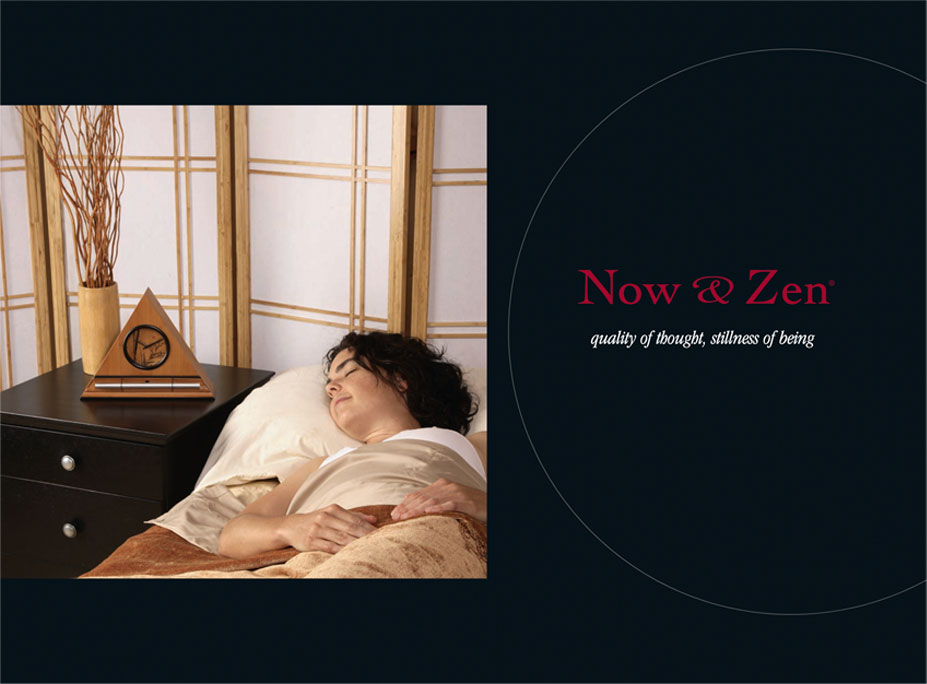
When the clock’s time reaches the alarm time and activates the alarm, its signature “progressive awakening” strike sequence begins with a single bowl strike.  Then automatically, three and a half minutes later, the clock strikes again … then in two minutes … then in one minute … so that the chime gradually continues over ten minutes.

Now & Zen Headquarter Store, 1638 Pearl St., Boulder, CO  80302  (800) 779-6383

Posted in Now & Zen Alarm Clocks, Zen Timepiece by Now & Zen, Zen Timers


Mindfulness bells and chimes by Now & Zen Inc.

Wednesday, June 29th, 2011
Stillness

Stillness

In the larger scheme of things, our days on this planet are few and precious, so it seems fitting that we should begin each day with grace and beauty. Used as an alarm clock, your Zen Timepiece thus serves as a useful reminder that each day is a new and sacred opportunity to live life to its fullest.

Zen Timepiece in Maple

Zen Timepiece in Maple

But in addition to its use as an alarm clock, your Zen Timepiece is also an aesthetically-sophisticated timer that enhances practice activities and social gatherings. It can also serve as a “mindfulness bell” that periodically calls you to stillness.

Founded in Boulder, Colorado in 1995, Now & Zen’s mission is to create natural lifestyle products that make a real difference in people’s lives. The growing preference for natural foods and natural fibers is carried forward by Now & Zen in the natural acoustic sounds and natural hardwood materials featured in every Now & Zen product. Our way of describing the essence of a natural lifestyle is: quality of thought, stillness of being.

Posted in Meditation Timers, Meditation Tools, Natural Awakening, Now & Zen Alarm Clocks, Zen Gardens, Zen Timepiece by Now & Zen, Zen Timers


Zen Clocks for meditation

Sunday, June 26th, 2011
Cherry Blossoms

Cherry Blossoms

Beyond the psychological inquiry into dreams or the self-improvement techniques of affirmations lies the ancient and sacred practice of meditation.  Some form of meditation is practiced in every major world religion.  Yogis, Christian mystics, Zen Buddhists, Quakers, practitioners of the Kabbalah, and Secular Humanists, all experience the benefits of meditation.
A Moment of Stillness in Nature

A Moment of Stillness in Nature

The Zen Timepiece is an exquisite “accoutrement to meditation.”  It can be used in a variety of ways to aid your practice and encourage you to “make time” to meditate.  The first and most basic use of the Zen Timepiece in your meditation practice is as a signal of the end of your allotted meditation time.

If you want to meditate for twenty minutes, simply set the countdown timer for twenty minutes and begin your meditation.  When the countdown timer reaches zero and the bowl/gong is struck, you can choose to end there or continue your meditation for about three and a half minutes until the next bowl strike, or even longer.  Many meditators find that a “three and a half minute warning” is a perfect interval in which to gradually conclude their longer meditations.  The first strike signals the final phase of the meditation and the second strike its conclusion.  The beauty of the brass bowl/gong is that it complements rather than disturbs the meditative state while acting as an effective timer.  No matter how you use it, the sonic clarity of the brass bowl provides an appropriate conclusion to your stillness.

Now & Zen Headquarter Store, Boulder, CO

The bowl that comes with the Zen Timepiece is made from the following five metals: copper, zinc, lead, iron, and tin.  It has been formed using the same forging techniques that have been used in Asia for two thousand years.  Unlike hand-hammered Himalayan-style bowls, our Zen Timepiece’s rin gong bowl is made using methods which first appeared in Japan in the first century.  Following these traditions, your bowl’s long-resonating tone has been carefully selected to bring beauty and harmony to your environment.

Posted in Japanese Inspired Zen Clocks, Meditation Timers, Meditation Tools, Natural Awakening, Now & Zen Alarm Clocks, Progressive Awakening, Yoga Timers by Now & Zen, Zen Timepiece by Now & Zen, Zen Timers


3 Meditation Tips

Sunday, May 15th, 2011
three meditation tips

three meditation tips

Establish your basic practice.
Make sure you have the essentials of your meditation practice clear in your mind. In general, this means establishing a basic sitting posture, training yourself to breathe comfortably, and witnessing your mind from an inner distance—either focusing on your breath or a mantra.

Add time in small increments.
Begin by sitting for 10 to 12 minutes on a regular basis. When you are ready, increase your sitting time to 15 minutes. Then, work your way up to 20 minutes. At that point, your meditation will be well established.

Don’t take on too much.
Ultimately, the length of your meditation will be determined by your mind’s capacity to concentrate. The key to sitting longer is to relax and deepen the process of concentration. From a practical point of view, when the mind becomes so tired of concentrating that you are no longer engaged in the process, the meditation is moving toward its end.

adapted from Yoga International by Rolf Sovik, May/June 2007

Meditation Timers and Clocks with Chime in Bamboo, Walnut, Maple, and Black Lacquer

Meditation Timers and Clocks with Chime in Bamboo, Walnut, Maple, and Black Lacquer

Now & Zen

1638 Pearl Street

Boulder, CO  80302

(800) 779-6383


Posted in Meditation Timers, Meditation Tools, Well-being, Zen Timers, mindfulness practice


Bach’s Wake-Up Call

Tuesday, May 3rd, 2011
acoutic music

acoutic music

The theme of spiritual life as a kind of awakening is a metaphor found in every culture and tradition. You might enjoy listening to music by the great German composer Johann Sebastian Bach, who chose the theme of awakening for a cantata he composed in 1731. Inspired by the Gospel of Matthew 25:1–13, it opens with the words, “Wachet auf, ruft uns die Stimme” (Sleepers awake! The Voice calls to us).

adapted from Yoga International, by Rolf Sovik, PsyD,  The author of Moving Inward: The Journey to Meditation

acoutic musical alarm clocks with chime

acoutic musical alarm clocks with chime


Now & Zen

1638 Pearl Street

Boulder, CO  80302

(800) 779-6383

Posted in Zen Timers


Sweet Sanctuary

Thursday, April 28th, 2011
 

how to design a sacred space

how to design a sacred space

Create a personal meditation space that inspires your practice and invokes your higher self.

If you’re a gardener, you know the value of choosing an ideal site and preparing quality soil for nurturing healthy plants. The same is true for tending to your inner growth: when you devote a nook in your home to your practice and sow it with your higher intentions, you create the right conditions for your spiritual life to thrive.

A dedicated space collects and focuses your energy, removes uncertainty about where to practice, and, through habit and association, helps the mind move inward more quickly and deeply. Much like an encounter with the refrigerator conjures thoughts of food, and a glance at the couch invites a comfortable sprawl, catching sight of your meditation seat in a sanctified space will evoke your deepest yearnings and inspire you to do your practice.

Choose a place that can become a sanctuary—a quiet, private space protected from outside distractions and out of public view. You may be fortunate enough to designate an entire room, but a corner in your bedroom will suffice.

You’ll need a meditation seat—traditionally known as your asana—which may be a neatly folded blanket topped by a cushion for support, or even a chair or bench. Keep any additional props needed to support a comfortable sitting posture nearby, as well as your mala, shawl, or journal; but otherwise keep the space uncluttered and scrupulously clean.

A simple altar will serve as the heart of your space, calling you to your practice by providing inspiration and focus. An altar is an acknowledgement of the deeper essence of life and a bridge to the unseen—a link between our life in the world of elements and the subtle world. All altars, even public ones, serve to remind us of meaning and purpose in life, and connect us to inner strength and guidance. In religious or ritual settings, an altar is the locus for offerings made to ancestors or deities. In the context of yoga meditation, an altar inspires an offering of inner resources rather than outward ceremony or ritual, so simplicity is key.

Carved Wooden Thai Buddha with Singing Bowl

Carved Wooden Thai Buddha with Singing Bowl

Try a small low table or a small chest of drawers at eye level, with a tasteful and simple covering. The objects you place upon your altar give focus, substance, and energy to your highest intentions. Traditionally, a flame (from a candle or a ghee lamp), water, flowers, fruit, and incense are offered on an altar to represent the gifts of the world given to us through the five elements. Often, these are joined by objects from a pilgrimage—a stone, sanctified water, or a sacred representation (such as a picture of Our Lady of Guadalupe or a carving of Lord Ganesha). The objects themselves are not as important as whether the altar uplifts the mind and touches the heart.

By creating a sacred space that encourages you to cultivate and nurture a devoted practice, you are one step closer to tasting the fruits of yoga—unconditional well-being and pure awareness.

adapted from Yoga International by, Sandra Anderson / co-author of Yoga: Mastering the Basics and has taught yoga and meditation for over 25 years.

zen alarm clocks and chimes for a gentle awakening

zen alarm clocks and chimes for a gentle awakening

Now & Zen

1638 Pearl Street

Boulder, CO  80302

(800) 779-6383

Posted in Chime Alarm Clocks, Well-being, Zen Timers


Massage Your Nervous System by Just Breathing

Thursday, March 10th, 2011
yoga

yoga

There is one yogic breathing technique that can be practiced at all times of the day and night by just about anyone.  This pranayama (breath control) is called ujjayi.

Ujjayi means “victorious.”  The prefix ud means upward and superior, and jaya (from root ji) means to conquer and have victory over.  With consistent practice of ujjayi breath, a practitioner will attain victorious results for both body and mind.

The benefits of ujjayi breath are manifold.  In addition to aerating the lungs and removing excess phlegm, it boosts endurance and gently warms the body.  This soothing breath massages and tones the entire nervous system, making it an excellent way to combat stress.  It’s also believed to help counter high blood pressure.

While one should initially learn ujjayi breath in a seated position, in can later be consistently threaded through the entire asana practice.

Here’s how to practice:

1.     Sit in a comfortable, upright meditation position (I encourage sitting on a folded blanket or pillow for extra support)

2.     Maintaining a tall spine, close eyes and begin to breath normally through both nostrils.  Observe the flow of the air in and out of the body.

3.     Once you’re familiar with the course of the breath, take a deep, slow breath in through the nostrils.  Try to focus the air in on the palate and back of the throat and create a sibilant sound (saaaa).  It should be an ocean like sound, or like having your ear against a conch shell.  Fill the lungs entirely and then…

4.     Breath out slowly, focusing the air on the back of the throat/palate.

The sea-like sound is caused by a subtle constriction of the glottis, which is the aperture of the larynx.

The breath should be just loud enough that someone sitting close to you would hear it.   Avoid being too loud of forceful.  I’m fond of esteemed Ashtanga teacher Tim Miller’s description of ujjayi, “Imagine sipping the breath in through a straw. If the suction is too strong the straw collapses and great force is required to suck anything through it.”

5.     Set your Zen Timer with Tibetan Bowl for 15 minutes.  Continue to breathe for 5 to 15 minutes with this ocean like sound.  If possible, take a brief savasana after.

More experienced practitioners, commit to carrying ujjayi breath through your entire asana practice.  Let it be metronomic in quality.

Observe how much space you’ll discover in body and mind!

Sophie Herbert is an alignment focused yoga teacher (and perpetual student), a singer-songwriter, and a visual artist. She has lived, studied, and volunteered extensively in India; teaches yoga in Brooklyn and Manhattan; and recently released her first full-length album, “Take a Clear Look.” Please visit her website at SophieHerbert.com.

adapted from Wholeliving.com February 2011

Chime Alarm Clock for a Gentle Wake up, www.now-zen.com

Chime Alarm Clock for a Gentle Wake up, www.now-zen.com

Posted in Chime Alarm Clocks, Yoga Timer, Yoga Timers by Now & Zen, Zen Alarm Clock, Zen Clocks and Dream Recall, Zen Timers, yoga, zen


Jaw and Neck Release

Monday, February 28th, 2011
Jaw and Neck Release

Jaw and Neck Release

Stretch The Stress Out
 

What it does: Releases tension from the jaw, neck, and shoulders; deepens breathing.

How to do it: Sit tall in a chair. Inhale deply; as you exhale, make a “ha” sound, gradually opening your mouth as far as you can without straining your jaw muscles. Let gravity do most of the work. Close your mouth as you inhale and repeat eight to 10 times, opening your mouth wider while using less muscular effort each time.

Now focus on the neck. Still sitting tall, drop your chin toward your chest and take several breaths. Then tilt your head back and look up at the ceiling for several breaths. Bring your head back to the center, inhale, and then turn and look to the right as you exhale. Pause for an inhale, then exhale as you slowly rotate your head to look left. Inhale, then exhale as you rotate your head to the right. Continue until you’ve looked right and left five times each.

adapted from Body + Soul

Yoga timers from Boulder, Colorado

Yoga timers from Boulder, Colorado


Now & Zen

1638 Pearl Street

Boulder, CO  80302

(800) 779-6383

Posted in Well-being, Yoga Timer, Yoga Timers by Now & Zen, Zen Timers, yoga


Unwrap the Tension

Friday, February 25th, 2011
yoga

yoga

Unless you’re a professional athlete, chances are you’re not getting a balanced workout during your workday. Whether you’re slaving away at a desk, making rounds, or waiting tables, you’re likely straining some muscles while ignoring others, leaving your body feeling stiff, sore, and physically exhausted. Deadlines and pressure from bosses don’t help matters, either. 

“When you get stressed, you often hold your breath, which leads to holding your muscles. It feels like you’re wearing a straitjacket,” explains Elaine Petrone, a stress- and pain-management expert and creator of the “Stop the Back Pain” DVD.

You can stretch out the stress, though, with a little time and effort. “By pairing mindful stretches with deep breathing, you’ll make lasting, positive changes to the way your body works, looks, and feels,” says Petrone, who helped us develop this rejuvenating routine. Done for 15 to 20 minutes, three times a week, it paves the way to a calmer, less achy, and more energized you.

adapted from Body + Soul Magazine

Zen Alarm Clocks and Yoga Timers with Gentle Chime

Zen Alarm Clocks and Yoga Timers with Gentle Chime

Now & Zen

1638 Pearl Street

Boulder, CO  80302

(800) 779-6383

Posted in Bamboo Chime Clocks, Well-being, Yoga Timer, Yoga Timers by Now & Zen, Zen Timers, yoga


Prepare for Your Own Meditative Tea Ceremony

Monday, February 21st, 2011

meditative tea ceremony

meditative tea ceremony

Prepare for Tea During The Winter Season.

In one traditional Japanese tea ceremony, guests are met at the gate by their host and led silently through a garden to the tea room, signifying a departure from the everyday world and an entrance into a spiritual realm.

You probably don’t have a dedicated tea room, but you too can create a space in your afternoon for disconnecting from the day’s stresses, whether you’re at the office or at home. Here’s our simple step-by-step approach to creating your own personal tea ceremony.

Dedicate a Space
This can mean moving to another room, a favorite chair, or just to the other side of your desk — or simply clearing a space for tea on your table or work space. You might consider using a place mat or a tray to visually set your tea space apart from everything else.

Set the Stage
A tea ceremony is about atmosphere. Light a candle or play music to set the mood. If you’re in a busy office, just close your eyes and listen to your breath for a few minutes to switch gears and set the tone.

Select Your Tea.
Bring some intention to your choice. What are you in the mood for? A mild, grassy green? A refreshing peppermint? A rich, vibrant oolong or black tea? As Confucius said, “Let your palate be your guide.”

Use Your Favorite Accoutrements
The personal objects you use for tea making will help make this practice your own. Whether it’s a pretty mug, an iron teapot, or a favorite infuser, using something special for your tea ritual inspires a ceremonial feel.

adapted from Body + Sou Magazine, 2005

Tea Ceremonies for Relaxation, tea timers with chime by Now & Zen

Tea Ceremonies for Relaxation, tea timers with chime by Now & Zen


 Now & Zen

1638 Pearl Street

Boulder, CO  80302

(800) 779-6383

Posted in Meditation Timers, Tea Ceremony, Zen Timers, intention


« Previous Entries Next Page »


Back
Share |
Zen Alarm Clock

Zen Alarm Clock
Digital Zen Alarm Clock

Digital Zen Alarm Clock
Zen Timepiece

Zen Timepiece
Zen Doorbell

Zen Doorbell
Tibetan Phone Bell & Timer

Tibetan Phone Bell
Integral Consciousness and the Future of Evolution by Steve McIntosh

Founder's Book & DVDs
Home Media Customer Reviews About Now & Zen Money-Back Guarantee Shipping Costs Blog

Contact Us   |   Wholesale Inquiries   |   Contact Customer Service   |   Catalog Request   |   Gift Cards   |   Product Videos


Copyright © 2012 Now & Zen, Inc., Boulder Colorado, USA all rights reserved. Sitemap | Privacy

ABOUT TRUST ONLINE